
This Black Friday, Sell a Package, Not a Discount
Skip the Black Friday discount on single sessions. Make a session package your seasonal offer and turn holiday shoppers into committed, long-term clients.
Olesia


Every November, your inbox fills with “40% off everything” and your feed fills with other businesses doing the same. If you sell your time by the session, as a coach, tutor, consultant, trainer, therapist, or wellness practitioner, it is tempting to join in: knock a chunk off a single session, post it on Friday, and hope the bookings roll in.
There is a better seasonal offer. Instead of making one session cheaper, make a multi-session package, sized to the result your clients want, the thing you promote for Black Friday week. Your usual rate, a clear start date, and a reason to say yes now.
This post is about the offer and the campaign: why a package beats a discount at this time of year, how to frame it, and how to promote it from Black Friday through Cyber Monday. If you still need to work out what your package should cost, our guide on how to price and sell session packages walks through the math. It uses personal training as the example, but the same approach works for any session-based service. Come back here when you have a number.
Why a Black Friday session discount works against you
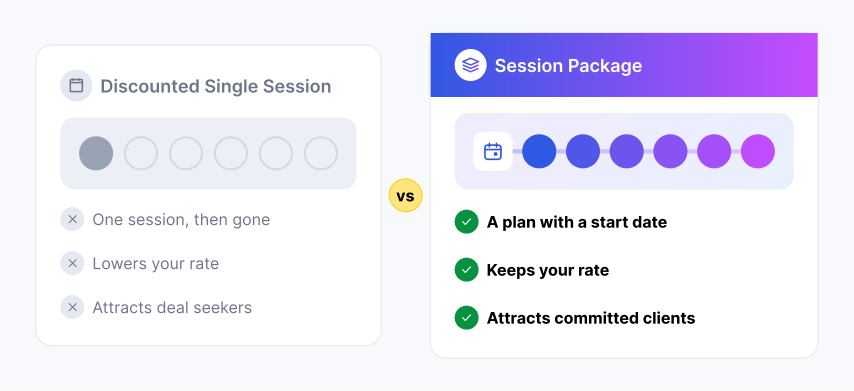
A discounted single session looks like a quick win. In practice, it tends to create three problems, whatever you sell.
It attracts one-time buyers
A cheap single session appeals most to people who want a cheap single session. Some will book once and never come back at full price. A tutor fills a slot with a parent shopping for a bargain rather than a semester of support. A consultant spends a strategy call on someone who was never going to hire them. You have used a peak-season slot on a deal hunter, not a client.
It resets what clients think you are worth
Once someone has paid a lower rate, your regular rate can start to feel like the “expensive” option. If you plan to raise rates in the new year, a November discount makes that conversation harder, not easier. (If a rate change is coming, our price increase notice guide covers how to announce it.)
It does not create momentum
Most session-based work gets results through consistency: a coaching client building a habit, a student working through a subject, a wellness client sticking with a routine. One session in late November, right before a busy holiday month, rarely turns into progress. The client gets a taste, then life takes over.
A package solves all three. It filters for people ready to commit, it keeps your rate intact, and it builds a run of sessions that actually produces results.
What makes a package the better seasonal offer
The point of a Black Friday offer is urgency: a reason to decide this week instead of “sometime.” A discount creates urgency with price. A package creates urgency with timing and a plan.
Here is what a seasonal session package gives clients that a discount cannot:
- A fresh start with a date on it. Late November is when people start thinking about January. New-year goals, a new semester, a new quarter. A package bought now means they start the year with sessions already on the calendar.
- A plan, not a coupon. A package gives clients enough time to set a goal, work toward it, and review progress. That is far easier to sell than “one hour, cheaper.”
- Commitment built in. When sessions are planned and paid for upfront, clients are more likely to show up. You are selling the progress, not just the hour.
And here is what it gives you: predictable income going into a typically slower holiday stretch, fewer one-off bookings to chase, and a group of clients who have already decided to work with you.
Our guide to selling coaching packages instead of single sessions covers the general case for packages. The difference here is the season: Black Friday gives you a natural deadline to build a short campaign around.
How to turn a session package into a Black Friday offer
You do not need to rebuild your services. You need to package the package: give it a seasonal name, a clear window, and something that makes this week special without cutting your rate.
Size it to the result
There is no magic number. Start from what the client wants to achieve and how many sessions that realistically takes, then build the package around it. For example:
- A short block (3 to 4 sessions) for a focused goal, such as a consultant’s planning sprint or a few sessions to prepare for an exam
- A mid-length block (6 to 8 sessions) for building a habit or working through a defined program
- A longer block (12 sessions or more) for ongoing coaching, a full semester of tutoring, or a season-long wellness plan
If you already sell packages, use the one clients buy most. You can offer two sizes, but keep it to a small choice so the decision stays easy.
Give it a seasonal name
“Session package” is accurate but forgettable. A seasonal name tells people what it is for. A few ideas across different services:
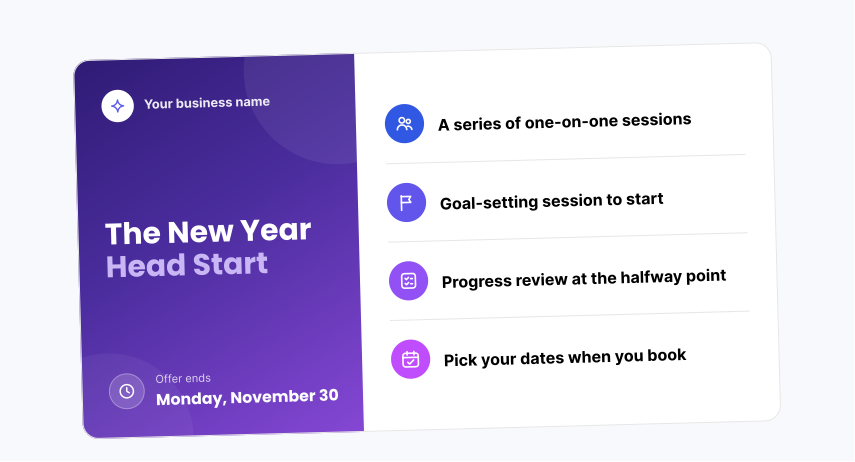
- Coach: The New Year Head Start
- Tutor: Ready for Finals
- Consultant: The Q1 Strategy Sprint
- Wellness practitioner: The Winter Reset
Keep the name tied to an outcome or a moment in time, not to a price.
Set a short, honest sales window
Black Friday offers work because they end. Pick a window, such as Friday, November 27, through Monday, November 30, and stick to it. Say the end date in every post and email.
If you have limited availability, say so plainly. “I have room for six new package clients starting in January” is honest scarcity. Do not invent limits you do not have.
Add value instead of cutting price
If you want this week’s offer to feel special, add something that costs you little time and means a lot to the client. Depending on what you do, that might be:
- A goal-setting or kickoff session at the start
- A short progress review at the halfway point
- A written summary, study plan, or action plan to keep between sessions
Whatever you add, define it clearly and make sure your booking page and your posts describe the same thing.
Keep the price your price
Show your standard package total. If your regular package is already good value, say why: a set of planned sessions, a clear goal, and a progress review. The pricing guide explains how to present one clear total, and our guides on how to charge for tutoring and how to charge for consulting cover rate-setting for those services, so we will not repeat it here.
Decide who it is for
A seasonal package is not right for everyone. It suits:
- Current clients who book one session at a time and would benefit from a plan
- Past clients who drifted off and want a reason to restart
- New clients who are ready to commit, not just curious
For someone who is not ready to commit, offer a single session at your normal rate, or a discovery call to talk it through. There is no need to push a full package on someone who wants to try one session.
How to promote your package from Black Friday to Cyber Monday
A short campaign beats one lonely post. Here is a simple four-touch plan.
Tuesday or Wednesday: tell your current clients first
Your existing clients are your warmest audience. Mention the package at the end of a session and send a short email. Something like:
I’m opening a New Year Head Start package this weekend for clients who want a plan going into January. You’ll pick your dates when you book, and we’ll start with a goal-setting session. Want me to save you a spot?
A tutor might write the same note to parents about the spring semester; a consultant might frame it around Q1 planning.
Friday: launch publicly
Post the offer on social media with the name, what is included, the total, the end date, and one link to book. Keep it to one clear call to action.
Saturday or Sunday: share the “why”
Post a short story or example: what a run of consistent sessions looks like, and what someone can expect by the end. Focus on outcomes and consistency, not on price.
Monday: last call
Send a brief reminder that the offer closes tonight. Restate the name, what is included, and the link. Then close it when you said you would.
Make the link do the work
Every touchpoint should point to one place where people can see the package and book it. If clients have to message you to ask about dates, then wait for a reply, then send payment separately, you lose people at each step. A booking page that shows the offer, the dates, and the payment in one flow keeps more of the people who click.
Put your package behind one booking link
Packages and session tracking are included on the Professional plan.

What happens after the clients say yes
Selling the package is the start. A few things keep the season from turning into a scramble.
Get the sessions on the calendar. When clients choose their dates as part of booking, you start January with a full schedule instead of a stack of open sessions to coordinate. For clients who prefer a fixed weekly slot, such as a Tuesday tutoring session or a standing coaching call, recurring bookings make that easy.
Set expectations about changes. The holidays are busy. Have a clear policy on cancellations and rescheduling before you sell, and show it on your booking page. Our cancellation policy guide walks through how to add one.
Know where every client stands. Keep track of how many sessions each client has used and how many remain, so you can answer “how many do I have left?” in seconds.
Plan the next step early. With a few sessions left in the package, start the conversation about what comes next. Clients who finished a package with you are your best candidates for the next one. For more on keeping clients long term, see our guide to customer retention strategies.
Sell your package with Calfrenzy
Calfrenzy’s Professional plan includes packages and session tracking, so you can set up your seasonal package, let clients book it, and see sessions used and remaining per client. It also includes recurring bookings, custom session durations, intake forms, custom email reminders, Zoom and Microsoft Teams for online sessions, and Stripe payments, with Apple Pay and Google Pay supported.
Professional is $7.99 per month billed annually, or $9.99 billed monthly. You can try Calfrenzy free for 14 days with no card required.
This Black Friday, skip the race to the bottom. Give your clients a plan, a start date, and a reason to commit, and keep your rate where it belongs.
Set up your package in Calfrenzy
Packages and session tracking are included on the Professional plan. Try Calfrenzy free for 14 days with no card required.
Get Started FreeRelated Articles

How to Build a Booking Page That Actually Converts
A booking page converts when it answers every question a client has before they reach a wall — then keeps the next step in reach. Lead with your brand, show clear session options, spell out what’s included, add real proof, and keep the booking button visible the whole way down.

How to Sell Coaching Packages Instead of Single Sessions
A client who commits to a block shows up, does the work, and gets a result worth referring. Here’s how to structure a package, frame its value, and — the part most guides skip — let clients book and pay for the whole thing in one checkout.

Recurring Lesson Scheduling: How to Book a Full Term at Once
Book a repeating series of lessons — every Tuesday at 4pm for a term — as one series instead of scheduling each lesson individually. How recurring scheduling works, when to use it instead of one-off or multi-session booking, and how to set up a full term without the weekly admin.
Ready to Grow Your Practice?
Set up your booking page in under 2 minutes. Packages, payments, and reminders included.


