
How Much to Charge for Piano Lessons in 2026 (Rates, Lesson Lengths and Term Billing)
Calfrenzy Team


Private piano lessons in the US run $40 to $80 per hour on average, with 30-minute sessions starting around $30, according to Lessons.com's cost data — and group piano classes cost $20 to $50 per session. Where you land in that range depends on which of piano's two markets you're serving: price-sensitive beginners, or exam and audition students who pay for your record.
This guide is for the teacher setting the rate. It covers the verified ranges, the beginner/advanced split that makes one blanket rate a mistake, how to price 30, 45 and 60 minutes so the middle length doesn't undercharge, and the billing model that fits how families already plan piano — the school term.
Teaching more instruments than piano? The general version of this guide, with rates across formats, is our music lesson pricing guide.
What piano teachers charge
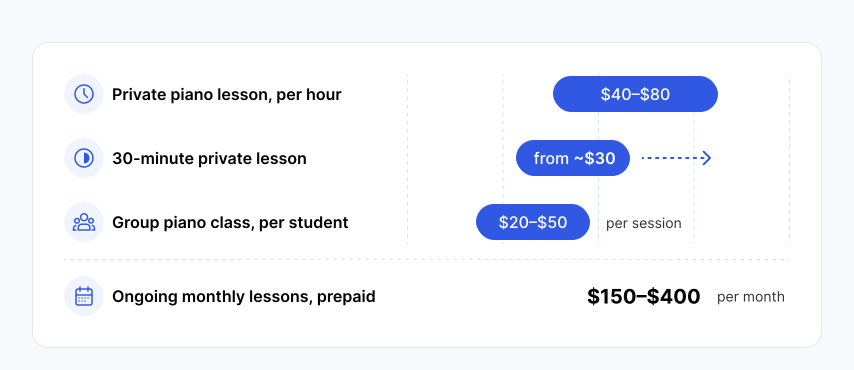
Sources: Lessons.com; Outside The Bachs. Retrieved 29 Sep 2026. Local markets vary.
The published US figures:
Format | Typical Range | Source |
|---|---|---|
Private piano lesson, per hour | $40–$80 | Lessons.com |
30-minute private lesson | from ~$30 | Lessons.com |
Group piano class, per student per session | $20–$50 | Lessons.com |
Ongoing monthly lessons, prepaid (music lessons generally) | $150–$400/month | Lessons.com |
Private music lessons, national range (all instruments) | $50–$100/hour, higher in major metros | Outside The Bachs |
Sources: Lessons.com music and piano lesson cost data; Outside The Bachs rate calculator. Retrieved 29 September 2026. Local markets vary widely — check what three comparable teachers near you charge before anchoring on any national table.
Piano sits toward the middle of instrument pricing: high demand keeps the volume strong, but high teacher supply — piano is the most-taught instrument — keeps beginner rates competitive in a way that oboe or harp teachers never face. That supply pressure is exactly why the two-market split in the next section matters more for piano than for any other instrument.
The two piano markets
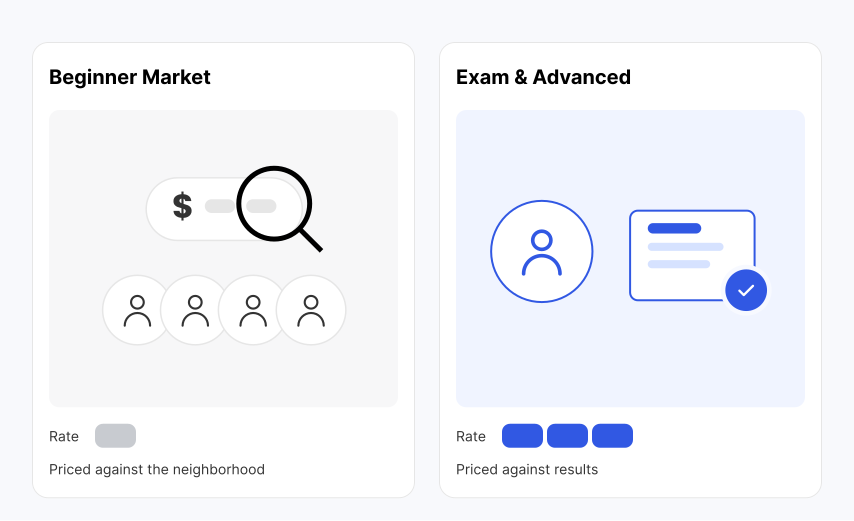
Piano teaching is really two businesses, and pricing them with one number underprices one or scares off the other.
The beginner market is parents booking a seven-year-old's first lessons. It's enormous, it's local, and it comparison-shops on price and convenience before credentials — a conservatory diploma doesn't move a parent choosing between two teachers ten minutes apart. Here your published rate needs to be visible and in the local range: this is the market where being $15 above the neighborhood average with no stated reason costs you the enquiry. Win it on the experience around the lesson — easy booking, clear communication, recitals — not on being cheapest.
The exam and advanced market — ABRSM/RCM exam prep, audition coaching, serious adult learners — decouples from local comparison entirely. These students are buying outcomes and your record delivers them, so this rate is set by results, not the neighborhood: multiples of the beginner rate are normal and correct. If your exam students pay your beginner rate, this is the single biggest number to fix.
The practical structure: publish two rates (or a rate and a named program). "Lessons — $X" for the beginner market; "Exam preparation / Advanced study — $Y" as its own offer with its own description. The separation isn't just pricing — it tells the advanced student they're buying a different product, which is what justifies Y.
Pricing 30 vs 45 vs 60 minutes
Piano is the instrument of the 30-minute lesson — young beginners' attention and hand stamina suit it — which creates a pricing trap: the half-hour rate is your busiest product, so it quietly becomes the anchor for everything.
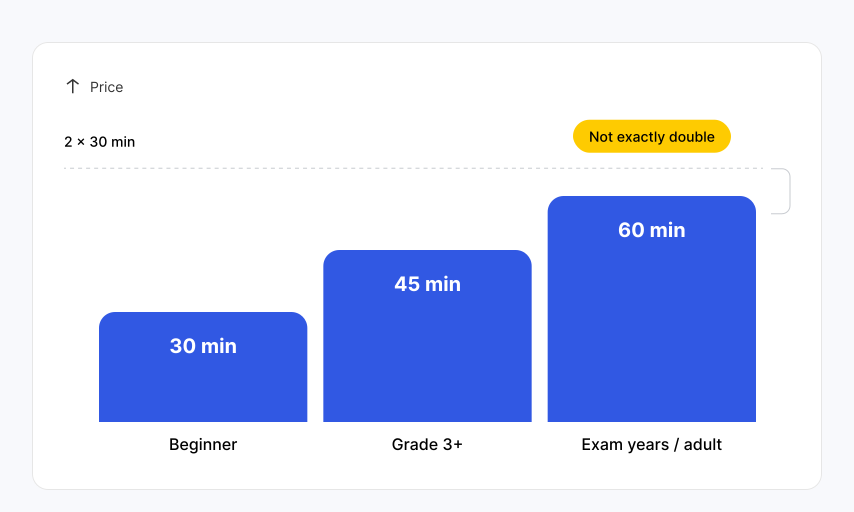
Don't price 60 minutes at exactly 2 × 30. Your fixed costs per lesson — the scheduling, the parent messages, the changeover gap between students, the notes — are the same whether the lesson is 30 or 60 minutes. Pricing the hour at a modest premium under double (or the half hour at a premium over half) reflects that; most teachers do it by setting the 30-minute rate slightly rich rather than discounting the hour.
45 minutes is the upgrade path, price it like one. The move from 30 to 45 minutes is where a progressing child stops running out of lesson before running out of material. Price it clearly between the two — if 45 costs almost what 60 costs, parents skip to 60; if it's barely above 30, you've given away the upgrade.
Match length to stage, and say so. A published guide — beginners 30, grade 3+ 45, exam years 60 — does two jobs: it makes the longer lesson a milestone rather than an upsell, and it gives the renewal conversation a natural script: "next term I'd move her to 45 minutes."
Term billing: the model piano was made for
Piano lessons already run on the school calendar — parents think in terms, not weeks. Billing that matches how the family plans is the least-friction structure there is: a term of Tuesday lessons, booked and paid once, renewed at the term boundary (where your price changes also naturally land).
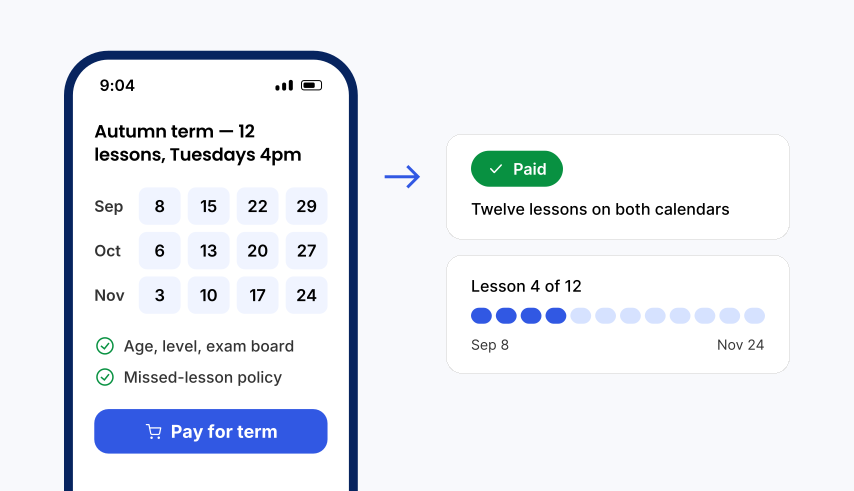
What stops teachers doing it is the admin, and that's a tooling problem — we build Calfrenzy, so read this part accordingly. On a Calfrenzy booking page the term is the product: the parent picks the weekly slot, sees all twelve dates on the calendar, answers your intake questions (age, level, exam board), ticks your missed-lesson policy and pays for the term in one checkout. One decision, one payment, twelve lessons on both calendars — instead of twelve small weekly decisions, any of which can quietly become a skipped week.
The conversion detail that matters for a studio: the booking page is where a parent decides, often on a phone, often at 9pm — so the page itself is part of your pricing power. A clean, branded page that shows the term, the dates and one price (premium booking page design comes with the Professional plan) closes the parent who would have "replied tomorrow" to an invoice email. Packages and payments are on the Professional plan; there's a free trial, no card required.
Put next term on a booking page — the renewal email then writes itself: same slot, here's the link.
Frequently asked questions
Start from the published range — $40–$80 per hour, 30-minute lessons from about $30 (Lessons.com) — then position within your local market and split your pricing: a competitive published rate for beginners, a separate higher rate for exam and advanced work.
For families: private piano runs $40–$80 per hour in the US on average, with half-hour lessons from around $30 and group classes $20–$50 per session (Lessons.com). Many teachers bill by term or month rather than per lesson.
Typically from about $30 (Lessons.com), rising with the teacher's experience and market. Thirty minutes is the standard length for young beginners; students usually move to 45 or 60 minutes as they progress.
Beginners and young children: 30 minutes matches attention and hand stamina. From roughly grade 3, 45 minutes; exam years and adults, 60. Publishing that ladder makes the longer lesson a milestone, not an upsell.
All three models exist (per lesson, monthly tuition, term packages), but term billing fits piano best because families already plan by school term. A term booked and paid up front also holds the slot and ends the weekly cancel-or-continue decision. The trade-offs are covered in our music lesson pricing guide.
Sell the term the way families plan it
Put next term on a booking page — the renewal email then writes itself: same slot, here's the link.
Create Your Calfrenzy Account
Related Articles

How to Build a Booking Page That Actually Converts
A booking page converts when it answers every question a client has before they reach a wall — then keeps the next step in reach. Lead with your brand, show clear session options, spell out what’s included, add real proof, and keep the booking button visible the whole way down.

How to Sell Coaching Packages Instead of Single Sessions
A client who commits to a block shows up, does the work, and gets a result worth referring. Here’s how to structure a package, frame its value, and — the part most guides skip — let clients book and pay for the whole thing in one checkout.

Recurring Lesson Scheduling: How to Book a Full Term at Once
Book a repeating series of lessons — every Tuesday at 4pm for a term — as one series instead of scheduling each lesson individually. How recurring scheduling works, when to use it instead of one-off or multi-session booking, and how to set up a full term without the weekly admin.
Ready to Grow Your Practice?
Set up your booking page in under 2 minutes. Packages, payments, and reminders included.


