
How to Start a Consulting Business: 10 Steps From First Idea to First Client
Olesia


You know your field, and people already ask you for advice. Turning that into a consulting business is mostly about making a handful of clear decisions in the right order, then making it easy for clients to say yes.
This guide is for solo consultants and small independent practices. It walks through the ten steps to start a consulting business, with a one-page business plan, a first-offer template, a simple pricing method and a launch checklist you can copy.
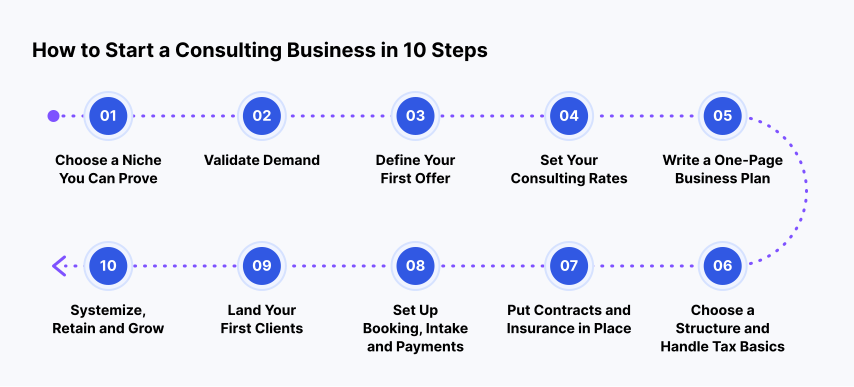
Quick answer: To start a consulting business, (1) choose a niche where you have proven results, (2) validate demand with real conversations, (3) define one clear first offer, (4) set your consulting rates, (5) write a one-page business plan, (6) pick a legal structure and handle tax basics, (7) put contracts and insurance in place, (8) set up booking, intake and payments, (9) land your first clients through your network, and (10) systemize and grow.
What is a consulting business?
A consulting business sells expert advice and hands-on help to solve a specific problem for a client. You might diagnose what's wrong, recommend a fix, help implement it, or guide a team through it. Clients pay for your judgment and results, usually by the project, on a monthly retainer, or by the hour.
Most new consulting businesses start as one person with one skill set: a marketer helping SaaS companies with positioning, an HR lead helping startups write their first policies, an engineer advising on cloud costs. You don't need an office or staff. You need a problem people will pay to solve, and proof you can solve it.
Is starting a consulting business right for you?
Pros | Cons | |
|---|---|---|
Money | Low startup costs | Uneven income, especially in year one |
Time | You choose clients and schedule | Selling and admin take hours you can't bill |
Risk | Easy to start part-time | No employer benefits; you handle taxes and insurance |
If uneven income worries you, start part-time and switch once you have one or two regular clients. Check your employment contract for non-compete or moonlighting clauses first.
Step 1: choose a consulting niche you can prove
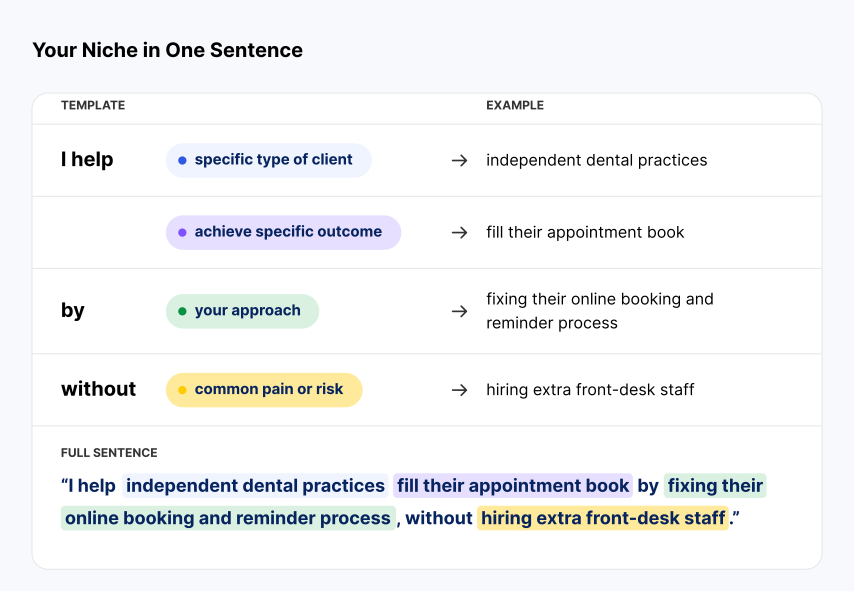
A niche is who you help plus what problem you solve for them. "Marketing consultant" is a job title. "I help B2B software companies under 50 people turn free trials into paid customers" is a niche, and it's far easier to find, refer and pay.
To find yours, list problems you've solved repeatedly (with results you can describe), industries you know well, and the questions people already ask you for free. Pick the overlap where you have the most evidence. The best consulting business ideas usually come from your last two or three jobs, not from a list of trending industries.
Template:
"I help [specific type of client] [achieve specific outcome] by [your approach], without [common pain or risk]."
Example: "I help independent dental practices fill their appointment book by fixing their online booking and reminder process, without hiring extra front-desk staff."
Can you start a consulting business with no experience?
You can start without consulting experience, but not without expertise. Choose a narrow problem you've solved, even once or twice, offer a small low-risk project, and collect results and testimonials before you widen your scope.
Step 2: validate demand before you build anything
Before you pay for a logo or website, check that people will pay for your offer. The fastest way is to talk to them.
- List 20–30 people who match your ideal client or know people who do: former colleagues, managers, vendors, clients.
- Ask for 15–20 minutes to learn, not pitch. "I'm starting a consulting practice focused on X. Could I ask how you handle it today?"
- Ask about the problem and the money. What has it cost you? Have you paid anyone to fix it? What would make you hire outside help?
- Look for patterns. If several people describe the same pain and mention a past spend or budget, you have a market. If nobody has ever paid to solve it, refine your niche.
Step 3: define your first consulting offer
Clients don't buy "help with anything in marketing." They buy a clear result, with a clear scope, by a clear date. Start with one productized offer that's easy to say yes to:
Name:e.g., "Booking Funnel Audit"
Who it's for:e.g., independent dental practices with 1–3 locations
Outcome:e.g., a prioritized plan to increase online bookings
What's included:e.g., kickoff call, review of website and booking flow, short report, 60-minute walkthrough
Timeline:e.g., delivered within 3 weeks
Price:a fixed fee (see Step 4)
Next step after:e.g., optional implementation retainer
A small, fixed-scope entry offer (an audit, strategy session or roadmap) lowers the risk for a new client and often leads to a bigger engagement. Later you can bundle sessions into packages. The approach in how to sell coaching packages works for consulting packages too.
Step 4: set your consulting rates
There's no single right number for consulting fees, but there is a sensible way to work it out. Most consultants use one of three pricing models:
Model | How it works | Best for |
|---|---|---|
Hourly or day rate | You bill for time spent | Short advisory calls, unclear scope |
Project (fixed fee) | One price for a defined deliverable | Audits, strategies, implementations |
Retainer | Monthly fee for ongoing access or set sessions | Long-term advisory, fractional roles |
How much should you charge for consulting?
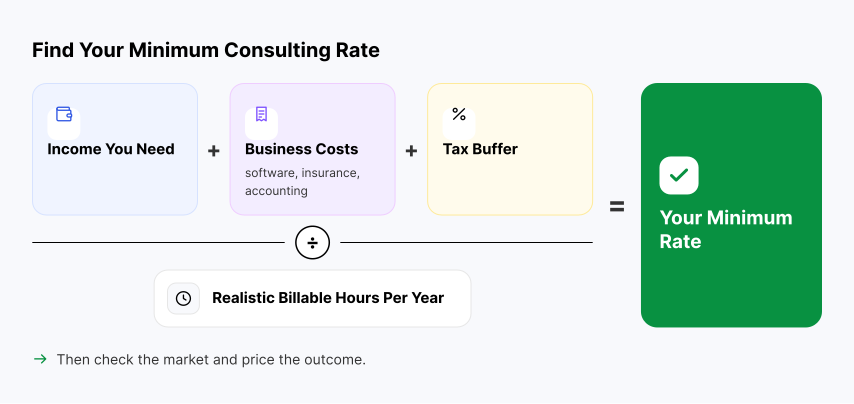
- Find your floor. Add the income you need, your business costs (software, insurance, accounting) and a tax buffer. Divide by realistic billable hours per year. Selling and admin take a real share of your week, so be conservative.
- Check the market. Ask peers, look at public rate cards in your field, and ask prospects what they've paid before.
- Price the outcome. If your work helps a client win or save a meaningful amount, your fixed fee can reflect that value, not just your hours.
If almost every prospect says yes without hesitation, you're probably too cheap. Raise rates for new clients first.
Step 5: write a one-page consulting business plan
Unless you're applying for a loan, you don't need a 40-page document. A one-page consulting business plan keeps your decisions in one place and makes it easier to turn down work that doesn't fit.
One-page business plan template:
Niche:who you help and the problem you solve
Offer(s):first offer, price, what's included
Ideal client:company size, industry, decision-maker, typical budget
Client sources:network, referrals, LinkedIn, partners, content
Revenue goal:monthly target and how many clients that takes
Startup costs:registration, insurance, software, website, accountant
90-day milestones:e.g., 30 conversations, 5 proposals, 2 paying clients
Step 6: choose a business structure and handle the basics
General information for US-based consultants, not legal or tax advice. Talk to an accountant or attorney, and check local rules if you're outside the US.
Sole proprietorship vs. LLC
According to the SBA, you're automatically a sole proprietorship if you do business without registering another structure. It's the simplest way to start, but your personal assets aren't separated from the business.
Many consultants form a single-member LLC instead. It's still simple to run and can help separate business liabilities from your personal assets. You don't legally need an LLC to consult, but some clients prefer contracting with a business entity.
Admin checklist
- Name your business. Your own name ("Jane Smith Consulting") is simplest. For a brand name, check your state's registry and file a DBA if needed.
- Register the business and get a free EIN from the IRS if you form an LLC or plan to hire.
- Check licenses for your city, state and field. Accounting, law, engineering and healthcare have their own rules.
- Open a separate business bank account.
- Plan for taxes. The IRS lists the self-employment tax rate as 15.3% (12.4% Social Security, 2.9% Medicare), on top of income tax. With no employer withholding, the IRS says individuals generally make estimated tax payments if they expect to owe $1,000 or more. Set aside a share of every payment from day one.
Step 7: put contracts, policies and insurance in place
Many guides skip this step, but it's what protects you when a project goes sideways.
Key documents every consultant needs
- Consulting agreement: standard terms for payment, confidentiality, intellectual property, liability limits and termination.
- Statement of work (SOW) or proposal: scope, deliverables, timeline and fee for each project. Spell out what's not included to prevent scope creep.
- Payment terms: when you invoice, when payment is due, and late-payment rules. For new clients, consider payment up front.
- Cancellation and rescheduling policy: notice required to move a session, and what happens with no-shows. Here's how to write a cancellation policy clients will respect.
Have a lawyer review your templates once, then reuse them.
Insurance for your consulting business
The most common policy is professional liability insurance (errors and omissions, or E&O), which covers claims that your advice caused a client a loss. General liability covers things like accidental property damage. Some clients ask for proof of insurance before signing, so get quotes early.
A scheduling tool built for consultants can handle most of this in one place, including discovery call booking, intake questions, reminders, buffer time, and multi-session packages or recurring retainer sessions paid at checkout. See Calfrenzy's consultant scheduling software.
Keep the rest of your stack small: a video tool (Zoom, Google Meet or Teams), proposal and e-signature templates, accounting software linked to your business account, and a simple CRM or spreadsheet to track leads and follow-ups.
Step 8: set up how clients book, pay and get onboarded
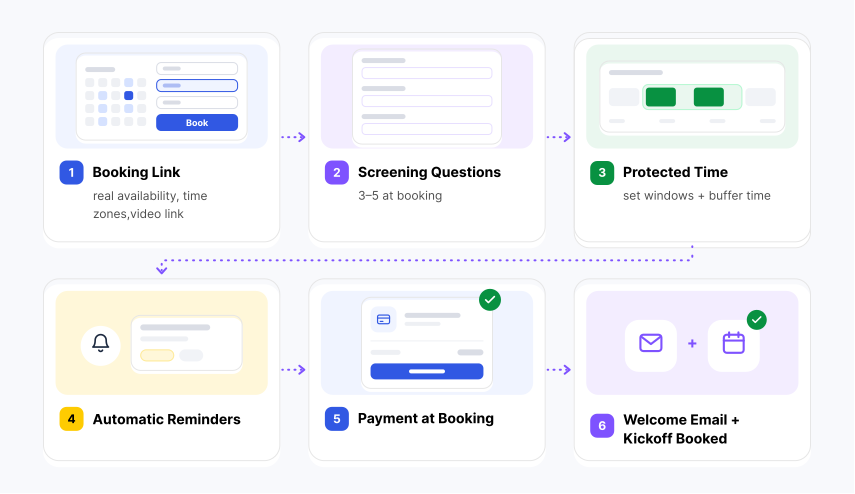
This is where new consultants quietly lose prospects. If booking a call with you takes four emails, some people won't bother. Set up a simple client journey:
- One booking link for discovery calls. It should show your real availability, handle time zones, and send the calendar invite and video link automatically. Add it to your website, LinkedIn, email signature and proposals. Here's how to build a booking page that converts.
- 3–5 screening questions at booking (what they need, timeline, company size) so you go into calls prepared. Adapt our client intake form template.
- Protected time. Offer discovery calls only in set windows, with buffer time between sessions for notes and prep.
- Automatic reminders before each call to cut no-shows.
- Payment at booking for strategy sessions, packages or retainers, so you're not chasing invoices. If you do invoice, use a polite payment reminder sequence.
- A welcome email explaining next steps, what you need from the client, and links to book the kickoff and follow-up sessions.
Step 9: land your first consulting clients
Your first clients will almost always come from people who already know and trust you. Start there before you spend anything on ads.
- Your network. Email 30–50 former colleagues, managers, clients and vendors. Say what you now do and who it's for, and ask who they know who needs it.
- Former employers. They know your work and may have projects nobody internally has time for.
- LinkedIn. Change your headline to your niche statement, add your booking link, and post about the problem you solve every week.
- Referral partners. Accountants, agencies and software vendors who serve the same clients can send work both ways.
Simple outreach message:
Then run a short discovery call, send a proposal within 24–48 hours, and follow up once or twice. For more channels, see how to get more clients.
Step 10: systemize, retain and grow
Once you have a few clients, shift from "find work" to "make the business easier to run."
- Turn projects into retainers. Offer a monthly check-in, a set number of advisory sessions, or implementation support at the end of each project.
- Ask for testimonials and referrals right after you deliver a result.
- Document your process: discovery questions, onboarding emails, proposal template and delivery steps.
- Review your rates every six to twelve months.
- Look after existing clients. These customer retention strategies work for consultants too.
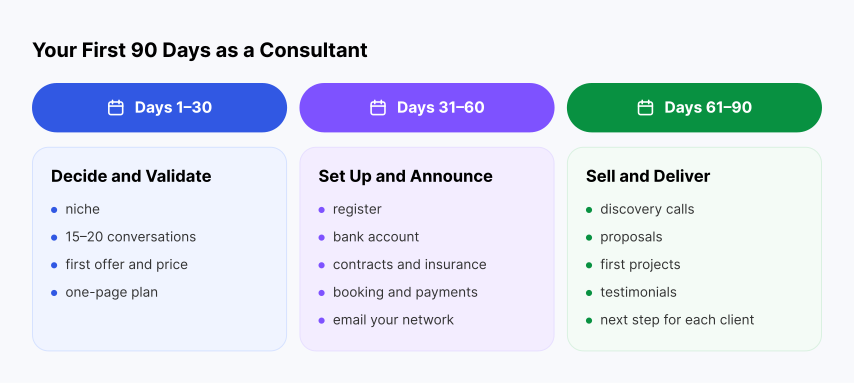
Your first 90 days: a simple plan
- Days 1–30: Decide and validate. Choose your niche, hold 15–20 validation conversations, define your first offer and price, write your one-page plan.
- Days 31–60: Set up and announce. Register the business, open a bank account, get contracts and insurance in place, set up booking and payments, email your network.
- Days 61–90: Sell and deliver. Run discovery calls, send proposals, deliver your first projects, collect testimonials, and offer each client a next step.
Consulting business launch checklist
- Niche statement written ("I help X achieve Y by Z")
- 15–20 validation conversations completed
- First offer defined: scope, timeline, price
- Pricing floor calculated and pricing model chosen
- One-page business plan done
- Business structure chosen, registered, EIN if needed
- Licenses checked and business bank account opened
- Tax savings plan set (estimated quarterly payments)
- Consulting agreement, SOW and payment terms ready
- Cancellation policy written
- Professional liability insurance in place
- Booking page with intake questions, reminders and payments live
- LinkedIn and website updated; announcement sent to your network
Frequently asked questions
Very little compared with most businesses. Main costs are registration, professional liability insurance, a simple website, scheduling and accounting software, and a one-time legal review of your contracts. Costs vary by state and industry. The bigger question is having savings or part-time income to cover the months before your client base is steady.
No. In the US you can consult as a sole proprietor, the default if you don't register another structure. Many consultants form an LLC to separate business liabilities from personal assets. Ask an accountant or attorney which suits you.
Focus on a narrow problem you've already solved in a job or side project. Offer a small fixed-price project, deliver a clear result, and collect a testimonial. Build your track record before widening your scope or raising your rates.
Demand follows the problems businesses are under pressure to solve right now, such as technology, AI, cybersecurity, finance and HR, plus any niche where a new regulation or tool creates urgent work. Look for the overlap between a problem you've solved and clients actively paying to fix it.
There isn't one official list. Versions vary by author, but they usually describe qualities of good consulting, such as competence, credibility, communication, commitment, collaboration, confidentiality and client focus. Treat them as a checklist, not a formal standard.
Usually by project (fixed fee), monthly retainer, or hourly or day rate. Taking payment up front or at booking reduces late payments.
Make it easy for clients to book you
Your booking process is often a client's first experience of working with you. Set up one link where prospects book a discovery call, answer a few screening questions and get reminders automatically. When they're ready to buy, let them book and pay for sessions or packages in the same place.
Create Your Free Consultant Booking Page
Related Articles

How to Build a Booking Page That Actually Converts
A booking page converts when it answers every question a client has before they reach a wall — then keeps the next step in reach. Lead with your brand, show clear session options, spell out what’s included, add real proof, and keep the booking button visible the whole way down.

Best Scheduling Software for Consultants in 2027
Find the best scheduling software for consultants in 2027: discovery calls, paid sessions and packages. See how the options compare.

How to Get More Clients in 2026
Get more clients in 2025 with 15 proven strategies—from AI-driven outreach to top scheduling software for small business. Build trust, streamline booking, and drive steady growth.
Ready to Grow Your Practice?
Set up your booking page in under 2 minutes. Packages, payments, and reminders included.


